Friday, March 20, 2015
In Our Mothers' House by Patricia Polacco
48 p., Philomel, 2009.
Narrated in the voice of a little girl grown up, this story recounts memories of growing up in a warm, loving family. The two moms, Meema and Marmee, have three children by adoption, each of a different ethnic background. The narrator remembers dancing with her family, celebrating holidays together, having block parties, being sick with a tummy virus, building a tree house, hosting the school's mother-daughter tea, and enjoying Nonno's (grandfather's) cooking. She loves that everyone in the family can speak freely, and recalls tenderly how her moms would do anything for the children. One neighbor is clearly prejudiced against them, which Meema and Marmee explain to the children as being full of fear and lacking in love; the family's other neighbors offer them support. When the children grow up and leave home, they return to marry in their mothers' garden and to share their own children's growing up with Meema and Marmee. After Meema and Marmee die, the narrator's younger brother lives in their house with his family. The house is home to the three now-grown children in the deepest sense of the word. With expressive pencil and marker illustrations, this story celebrates the joys of family life.
Ages 7-10

Monday, October 13, 2014
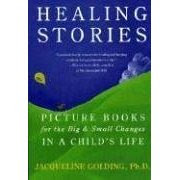
Healing Stories blog news
"Story of the week" posts have been appearing weekly for over eight years now, since September 2006, when Healing Stories was published. New posts will now be on hiatus for an undetermined time. I may perhaps post when I happen to run across a book that seems important to write about, but at least for a while, I won't be posting weekly. This blog will remain online so that the posts are available to you as a resource.
Wishing you and the children in your life healing in the stories you read and in the experiences you live.
Monday, October 6, 2014
Big Sister Now: A Story About Me and our New Baby by Annette Sheldon
Illustrated by Karen Maizel. 32 p., Magination, 2006.
When there's a new baby at home, you don't get to be the baby any more. At first, Kate doesn't like this. It feels confusing, and she worries that the adults have forgotten about her. Not only that, but when she needs something, she has to wait until baby Daniel's needs are met first. But she does get what she needs eventually, and her Mommy and Daddy are empathic. Kate starts to understand that although she doesn't like not being the baby any more, she does like feeling big. She begins to help take care of Daniel. Her wise Grandma, who up until now seemed only to be paying attention to Daniel, asks Kate to help her bake cookies - because Kate is big enough. This story includes an afterword for parents about how to help children adjust to a new baby. The illustrations convey emotion expressively. With Kate, children will learn that being big can still be as "warm and safe and lovey" as being the baby was.
Ages 2-6
Monday, September 29, 2014
The Sea Serpent and Me by Dashka Slater
Illustrated by Catia Chien. 38 p., Houghton Mifflin, 2008.
Sometimes being a friend means letting go. A little girl finds a beautiful sea serpent in her bathtub. They play together in the bath, and when it isn't bath time, she keeps him in a fish tank. The girl asks the serpent whether he misses the sea, and he says he does. In response, she promises to take him back, but the next couple of days are rainy, and she doesn't think that's good beach weather. In the meantime, the serpent is growing rapidly, and although she has mixed feelings about it, the girl realizes that if he grows any larger, she won't be able to take him home to the sea. So they go to the beach in spite of the rain. Knowing that people and serpents have different needs, and so need different homes, the girl says goodbye to the serpent. It's hard for both of them, but they take the time to share memories of their time together, the girl gives the serpent lots of reassurance about his life in the sea. When she's gone home, the girl finds comfort in her memories of the sea serpent. The story is illustrated with charcoals and semi-transparent washes of acrylic in a palette of greens and blues. Children will understand that there are times when it's best for both of you to put your friend's needs first, and that although this can be painful, it's bearable.
Ages 4-8
Monday, September 22, 2014
Always My Grandpa by Linda Scacco
Illustrated by Nicole Wong. 48 p., Magination, 2007.
When someone close to a child has Alzheimer's disease, the child may experience disbelief, worry, confusion, anger, and embarrassment. Such is the case for Daniel, who has always enjoyed spending the summers with Grandpa at the shore. On their way to a visit with Grandpa, Daniel's mother explains that he was diagnosed with Alzheimer's disease, and Daniel can't believe that things will be different - and at first, it seems as if they aren't. Grandpa still tells the same stories that Daniel has always loved, and they play catch as they always have. But soon it becomes clear that Grandpa has difficulty keeping track of his belongings, his memories, and his words. During a lucid moment, he tells Daniel that he's sorry this is happening, and even when he behaves in strange or confusing ways, he still loves Daniel. One day, after a walk on the beach during Grandpa's nap, Daniel and Mom return to his house to find a burning pan on the stove. Grandpa doesn't know who they are, which frightens Daniel. But they remind him of who they are, and he seems reassured. Daniel and Mom talk about their feelings, and he's able to verbalize some of his biggest fears: is Grandpa going to die? Are his parents? Mom responds with honesty and caring, and Daniel feels better. But then, when Daniel plays catch with a friend whom Grandpa has known for a long time, Grandpa asks who the friend is - three times during a short period. Embarrassed, Daniel asks his friend to play with him somewhere else, and then gets angry at his friend. His mother explains that Grandpa's behavior can be confusing to others, and she acknowledges Daniel's feelings. They agree to talk with the friend and his mother about Grandpa's diagnosis. For the rest of the summer, some days are better than others. Daniel seems discouraged about the changes in Grandpa - he's truly experienced them now. At the end of the story, Grandpa is coming to live with Daniel and his family. Having said at the beginning of the story that he won't allow Grandpa to forget him and Mom, on the way home, he tells Grandpa the stories that Grandpa has told him. Illustrated in ink and warm-toned watercolors, this story shows kids what Alzheimer's disease is like and offers them empathy and reassurance.
Ages 6-10
Monday, September 15, 2014
The OK Book by Amy Krouse Rosenthal
Illustrated by Tom Lichtenheld. 40 p., HarperCollins, 2007.
In this story, it's OK to be just OK at things. The main character is a stick figure consisting of the letters OK, drawn sideways. The character says, "I like to try a lot of different things. I'm not great at all of them, but I enjoy them just the same." The character is "OK" at many things, from roasting marshmallows to playing baseball, climbing to flying a kite. The character is definitely no better than "OK" at sharing.or flipping pancakes. But that's OK. At the end of the story, the character says, "One day, I'll grow up to be really excellent at something. I don't know what it is yet ... but I sure am having fun figuring it out." Children receive an important message about attending to their internal reactions to activities rather than focusing all their attention on being great at them. This is especially helpful for children who tend to be perfectionistic.
Ages 4-7
Monday, September 8, 2014
Won't You Be My Hugaroo? by Joanne Ryder
Illustrated by Melissa Sweet. 36 p., Harcourt, 2006.
There are lots of kind of hugs, from twirly hugs and tickle hugs, to cheer-up hugs and calming hugs, to friendly hugs and good-job hugs, to goodbye hugs and goodnight hugs. This book is an affectionate, cheerful, rhyming catalogue of these and others, with ink and watercolor illustrations of zebra, pig, and bunny friends and families. It also shows children a way to have a range of their needs happily met.
Ages 2-5
Monday, September 1, 2014
A Box of Friends by Pam Muñoz Ryan
Illustrated by Mary Whyte. 32 p., McGraw Hill/Gingham Dog, 2003.
When you move to a new home, you might think you have no friends there. Annie feels so alone at her new house that she wants to go back to the old, familiar one. When she tells her grandma that she has no friends in the new place, Grandma replies that everyone has a box of friends. She shows Annie hers. In the box are mementos of the special friendships in Grandma's life. Grandma is even a friend to herself. Annie wants to make her own box of friends, and Grandma helps her. When Annie is invited to another girl's birthday party, and is told that she can bring a friend, she brings Grandma. We understand that Annie has learned that she's brought friends with her to her new home - both in the connections that remain even when friends are far away, and in the people (and dog) whom she'd forgotten to think of as friends. Illustrated with wistful, light-washed watercolors, this story offers a way to move through the losses that come with a move.
Ages 5-8
Monday, August 25, 2014
My Name is Yoon by Helen Recorvits
Illustrated by Gabi Swiatkowska. 32 p., Farrar/Frances Foster, 2003.
When children move to a new country, they may feel alone and estranged. Yoon's family moves to the United States from Korea. Her father tells her that she has to learn how to write her name using the Western alphabet. Yoon doesn't like this - she likes it in Korean, the way it's always been. She likes the connection of that written form with her name's meaning, Shining Wisdom. When Yoon starts school, her teacher's first lesson is about a cat. She doesn't want to write "Yoon" on her paper, so she writes "CAT." On another day, she writes "BIRD" instead, and on another day, "CUPCAKE." Each time, the word is what she wants to be, in some way. As this is happening, she is beginning to make friends, her teacher is growing to like her, and she's learning things at school. When her mother expresses pride in this, Yoon can consider the possibility that America could be a good home for her. "Maybe different is good, too." Now she's willing to write "YOON" in English, and feels confident that it still means Shining Wisdom when written that way. Illustrated with expressive, light-filled paintings, this story helps children manage the complex feelings that immigration brings.
Ages 4-7
Monday, August 18, 2014
Ish by Peter H. Reynolds
32 p., Candlewick, 2004.
Criticism by others can lead to painful self-criticism and shutting down. Ramon loves to draw, but when his brother laughs at him, and hints that his drawings don't look like what he means them to look like, he questions himself. He can't make his drawings look "right." Finally, he stops drawing altogether. Then he discovers that his sister, Marisol, has been rescuing his discarded drawings and hanging them on her walls. The one that his brother had laughed at is one of Marisol's favorites. When Ramon says that it doesn't look like a vase of flowers, Marisol replies that it looks "vase-ish." As he looks at his drawings on her walls, he realizes that they really do look "ish", and gives himself permission to think and draw "ish-ly." He even begins to write "ish-ly." He lives "ishfully ever after." With expressive, charming, yet somehow scribbly-looking, illustrations rendered in ink, watercolors, and tea, this story shows children how to allow themselves to create from who they are, rather than what they think (or they think others think) they should be.
Ages 4-9
Monday, August 11, 2014
Little Pea by Amy Krouse Rosenthal
Illustrated by Jen Corace. 32 p., Chronicle, 2005.
Being fussy about what you eat can be a matter of perspective. Little Pea is a happy little pea who likes to play with his friends, roughhouse with his father, and listen to his mother's stories. But he hates to eat his dinner. Peas have to eat candy for dinner every night, and Little Pea thinks it tastes awful. Mama Pea and Papa Pea tell him that he has to eat at least five pieces of candy to be allowed to have dessert. So, reluctantly, he eats them, expressing disgust after each one. His promised dessert? Spinach - his favorite! With its simple, cheerful, ink and watercolor illustrations, this story helps children to have a sense of humor about picky eating - and who knows, maybe a new perspective, too.
Ages 4-8
Monday, August 4, 2014
Begin at the Beginning by Amy Schwartz
34 p., HarperCollins/Katherine Tegen, 2005.
When you expect too much of yourself, it's hard to do anything at all. Sara learns this when she's assigned to paint a picture on behalf of her class. She's had a bad day at school, and is discouraged to begin with. At first, she thinks she'll paint a picture of the tree outside her window, but then she decides that she has to come up with a "very important" subject for this painting. After a large after-school snack, she decides to paint the entire earth, and in fact, the entire universe. But she finds herself unable to begin. It goes on this way until dinner time, when her whole family has ideas about how she should do it, which they express in a distressing cacophony. After dinner, Sara explains to her mother that she was going to paint the entire universe, but she can't do it. Her mother encourages her to begin at the beginning, and reminds her that the universe is made of people just like them, and rooms and houses like theirs. Sara realizes that she really can begin with the tree outside her window, and that that's manageable for her. She finally begins to paint. With simple, expressive, charming illustrations in a gentle color palette, this story shows children how to give themselves permission to let go of unrealistic expectations - an important lesson for so many children to learn.
Ages 5-8
Monday, July 28, 2014
The Deaf Musicians by Pete Seeger and Paul DuBois Jacobs
Illustrated by R. Gregory Christie. 32 p., Putnam, 2006.
Sometimes our assumptions about disabilities turn out to be inaccurate. Such is the case for Lee, a jazz pianist who loses his hearing. The band leader fires him, asking, "Who will listen to a deaf musician?" Discouraged, Lee enrolls in a school for the deaf, thinking he can learn a new skill. He meets a man there, a saxophonist named Max, who questions his assumption that he can't play music any more. The two have long sign-language conversations about music, and eventually try playing a duet. They find that they play well together. Playing in the subway, they draw the attention of Rose, a bass player who signs, and whom they invite to join them. When they decide that they need a singer, Rose invites her friend, Ellie, a sign-language interpreter. The quartet plays daily in the subway, and Lee realizes that he's playing for his largest audiences ever. When his former band leader shows up with a compliment, Lee reminds him of his question - and Lee has an upbeat answer for it. An afterword celebrates the meaning of music that's beyond sound. With colorful illustrations that match the jazz theme, this story encourages children with and without disabilities to question their assumptions in positive ways.
Ages 4-8
Monday, July 21, 2014
Anna's Corn by Barbara Santucci
Illustrated by Lloyd Bloom. 32 p., Eerdmans, 2002.
Shared experience can be both a metaphor for loss and a way to move through the loss. in this story, set in the context of a farming family, Anna's Grandpa teaches her about the music that the corn makes in the fields - music that sounds to Anna just like Grandpa. Almost as if to commemorate the experience, he gives her kernels of corn to plant the next year. During the winter, Grandpa dies, and Anna misses him terribly. The corn seeds feel hard, just as she feels hard inside. She tells her mother that she doesn't plant them because she likes them as they am, and besides, if she buries them, like Grandpa, they'll be gone forever. But her mother reminds her that she won't hear the music in them unless she plants them. With this encouragement, she eventually does. True to her mother's word, the corn grows, and Anna hears its music. Anna saves some of these seeds to plant the following year. This story is illustrated with gently-colored pencil and pastel drawings. Rich in metaphor, it offers both empathy and hope to children who have lost someone close.
Ages 4-9
Monday, July 14, 2014
I Love You Through and Through by Bernadette Rossetti-Shustak
Illustrated by Caroline Jayne Church. 24p., Scholastic, 2005.
Here's a rhyming story that communicates being fully loved. The narrator loves everything about the character, inside and out, in all his moods, always. Cheerfully illustrated, this story celebrates the unconditional acceptance that parents and other special people feel for children.
Ages 0-3
Monday, July 7, 2014
Mommy in My Pocket by Carol Hunt Senderak
Illustrated by Hiroe Nakata.32 p., Hyperion, 2006.
When children go to school, they might miss their parents. In this sweet story, a little bunny imagines that she'll miss her Mommy when school starts. Although she could bring Mommy's picture with her, what she really wishes for - and the story elaborates on - is that Mommy would be tiny enough to fit in her pocket, so she could keep her there all day at school, next to her heart. She imagines the whole day like this. But she knows that even though that won't happen, she'll be all right at school, "because the love in Mommy's hug and kiss ... will stay with me all day!" This rhyming story is illustrated with tenderly colored, yet energetic watercolors. It offers empathy with children's wishes, along with reassurance that they can tolerate ordinary separations from parents.
Ages 2-6
Monday, June 30, 2014
Not A Box by Andrea Portis
32 p., HarperCollins, 2007.
With imagination, a box can be almost anything. In this story, an unseen character who doesn't understand this questions a little rabbit, who is making believe the box is a car, a mountain, a burning building, and many other things. The unseen character keeps asking about the box, and the rabbit answers that it's not a box. At the end, when asked, "Well, what is it then?" the rabbit answers, "It's my Not-a-Box!" Illustrated with line drawings that show the "real" things in black and the "imagined" ones in red, this story encourages transformation through imagination.
Ages 2-6
Monday, June 23, 2014
The Enchanted Wood by Ruth Sanderson
32 p., Little, Brown+, 19991.
Resolution of grief can be a difficult journey. In this original fairy tale, when the queen dies, the king's grief is so vast that the entire land experiences years of drought. A legend says that finding the Heart of the World, which is in the Enchanted Wood, will allow a man to achieve his purpose, and the king realizes that ending the drought is just such a purpose. The two oldest princes, both full of arrogance, first seek the Heart of the World. The wise woman who guards the gates of the Enchanted Wood warns them to stay on on the path, but each is distracted - the oldest by his love of hunting, and the second by his love of fighting. The youngest prince, Galen, goes to the wood, with not only a passion to save his kingdom (and his brothers), but also, openness and humility. As a result of the latter attributes, he acquires the help of the gatekeeper's daughter, Rose, who accompanies him on his journey. Seeing his brothers struggling, Galen is sorely tempted to leave the path, but he's able to stay on it when Rose warns him that he'll become enchanted if he leaves it. When, with her help, he understands that he'd wanted to leave the path because he loves his brothers, yet he's staying true to his purpose of saving the kingdom, the forest becomes much less forbidding. They reach the Heart of the World, where there is a magical tree and a spring. Drinking from the spring, Galen wishes for a permanent end to the drought. It immediately begins to rain. The wood is no longer enchanted, freeing Rose's family from generations of guarding its gate. Galen's brothers greet him warmly and with new humility, and the king holds a great feast. When Galen becomes king, he and Rose rule the kingdom with wisdom and joy. Illustrated with beautifully atmospheric oil paintings, this story illustrates the roles of compassion and connection in recovery from grief.
Ages 7-10
Monday, June 16, 2014
Let's Talk About It: Extraordinary Friends by Fred Rogers
Illustrated by Jim Judkis.32 p., Penguin Putnam, 2000.
When encountering a person with a disability is new to you, you might feel curious, surprised, or even scared. Mr. Rogers acknowledges all these feelings in this book about understanding disability in particular, and difference in general. He encourages children to talk about their concerns with adults, and suggests that able-bodied children make friends with disabled ones in the same way as with other people: by introducing themselves. In the context of acknowledging universal human experiences such as needing friendship and love, he educates children about ways to address differences. For example, he advises able-bodied children to ask before helping a disabled child, reminding them that they, too, sometimes want help, and sometimes not. Wisely, he remarks that as we get to know people, we learn much about them that isn't obvious from first impressions, and increase our self-knowledge as well. Illustrated wtih color photographs of children who are introduced on the first page, this book offers gentle, supportive, honest encouragement for understanding and looking beyond disability.
Ages 3-6
Monday, June 9, 2014
Mona: The Monster Girl by Moritz Petz
Translated by J. Alison James. Illustrated by Maja Dusíková. 32 p., North-South, 2004.
When you're a monster, you might be afraid of the children that could be hiding under the bed. Such is the case for green, sharp-toothed, claw-footed Mona, who worries about going to sleep even though her mother reassures her that there's no such thing as children. But in fact, two children do show up in her attic after she's gone to bed. At first, Mona is terrifed of the children, and of course, they're terrifed of her. One child, Lenny, shoots Mona with a water pistol, and he and Maria chase Mona. But Maria realizes that Mona is crying, and the children apologize to her. And they make friends. They find that they envy each other's lives - Mona's mother doesn't like her to be clean or to pick up her room. They teach each other their favorite games. And they discover that the Mona's mother can't see the children, and the children's mother can't see Mona. When Mona finally goes back to bed, she dreams of friendly children who want to play. This isn't the first story of a monster who is afraid of children at bedtime (for example, see The Something by Natalie Babbitt, 1970, Clyde Monster by Robert L. Crowe, 1976, and the hilarious No Such Thing by Jackie Koller French, 1997) but this one is lovely and made me laugh. Illustrated with whimsical watercolor paintings, this story offers children humor and a new perspective to help dispel their fears.
Ages 3-6
Subscribe to:
Posts (Atom)
About the Author

- Jacqueline Golding, Ph.D.
- Jacqueline Golding, Ph.D. is a psychologist in private practice in Pleasanton, California who works with children, teens, and adults. A graduate of Yale University, Dr. Golding earned her Ph.D. in psychology at the University of California, Los Angeles and completed a post-doctoral fellowship at the Central Contra Costa County Child, Adolescent, and Family Mental Health Service in Concord, California. She holds an appointment as Professor Emeritus at the University of California, San Francisco and has published over 100 articles in scientific and professional journals on topics such as trauma, depression, and cultural issues in mental health. Dr. Golding is represented by the Levine Greenberg Literary Agency.